The History of Avalon Hill: How One Baltimore Company Invented the Modern Board Game Hobby
The History of Avalon Hill: How One Baltimore Company Invented the Modern Board Game Hobby
There is a straight, unbroken line from a small print run of a game called Tactics, hand-assembled in a Baltimore basement in 1954, to the billion-dollar hobby board game industry of 2026. That line runs through one company — Avalon Hill — and one man, Charles S. Roberts, who quietly invented an entire art form and then, characteristically, walked away from it. This is the full history of Avalon Hill: how it started, how it built the modern wargame, how it dominated the hobby for four decades, why it collapsed, and why the imprint is still on the shelf today.
1. Charles S. Roberts and the Invention of the Modern Wargame (1952–1958)
Before Avalon Hill, wargaming as a civilian hobby barely existed. There were military kriegsspiel exercises going back to Prussia in 1812, H. G. Wells's Little Wars (1913) for tin soldiers on the drawing-room floor, and Fred Jane's early naval simulations. But there was no commercial game you could buy off a shelf that simulated a historical battle with a real map, real orders of battle, and a real combat resolution system. Charles S. Roberts changed that.
Roberts, a former Army officer working in Baltimore, designed Tactics between 1952 and 1954. It was an abstract modern-warfare simulation with a rectangular grid, unit counters with combat and movement values, a combat results table, and a rulebook. He founded The Avalon Game Company in 1952 to publish it and named it after the Avalon neighborhood of Baltimore County. The first printing of Tactics in 1954 is now universally regarded as the first modern commercial wargame. Encyclopedia Britannica, BoardGameGeek's historical archive, and the Museum of Play in Rochester all cite it as the point of origin. See: https://boardgamegeek.com/boardgame/5147/tactics and https://www.museumofplay.org/toys/tactics/.
By 1958 Roberts had reincorporated the business as The Avalon Hill Game Company and released two titles that would define the format forever: Tactics II, a cleaner second edition, and Gettysburg — the first commercial wargame based on an actual historical battle. Gettysburg 1958 introduced the essential wargaming vocabulary: an operational-scale map of a real battlefield, cardboard counters representing historical units, alternating turns, a combat results table, and terrain modifiers. Every hex-and-counter wargame published in the next sixty-eight years is descended from that box.
2. The Hex Grid, The General, and the First Golden Age (1961–1970)
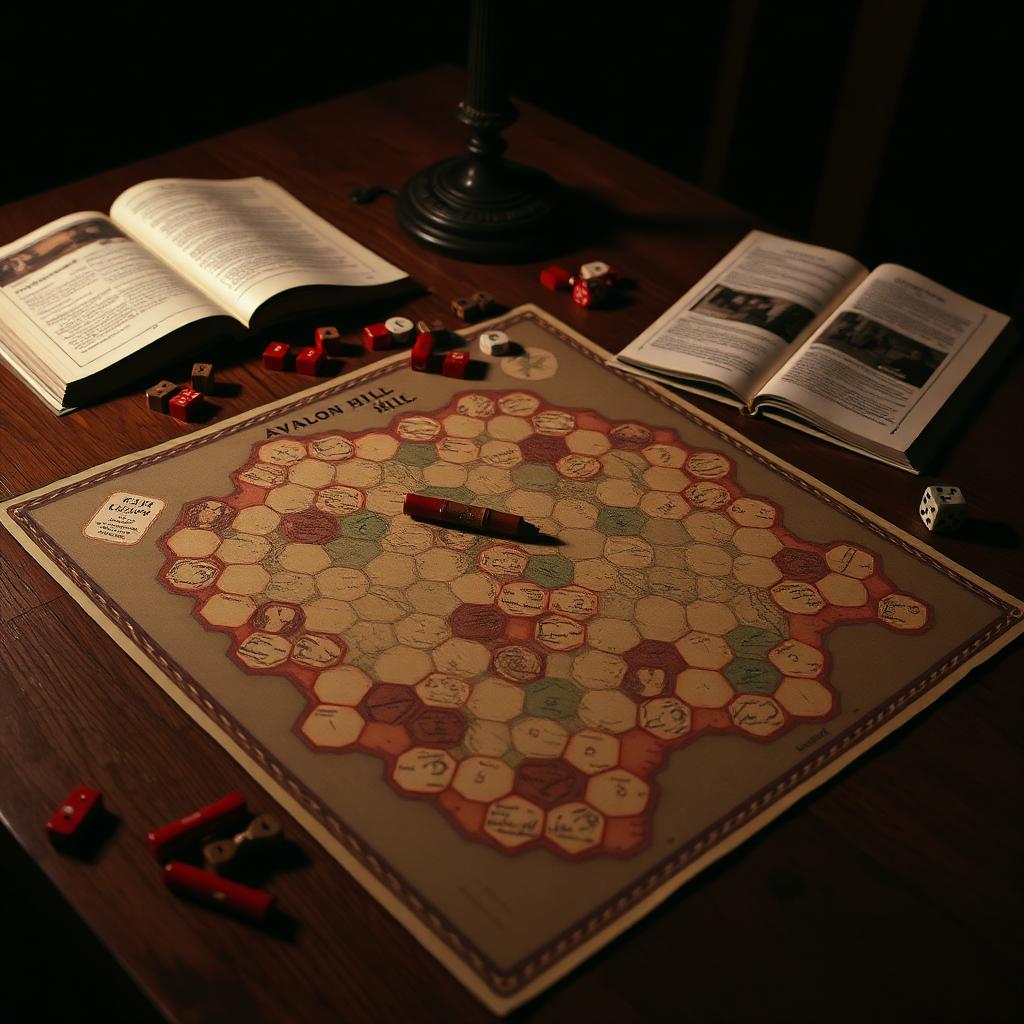
The hex grid — six-sided cells that give every space six equidistant neighbors, eliminating the diagonal-movement problem inherent in square grids — was introduced to commercial wargaming by Avalon Hill with Gettysburg's 1961 revised edition and cemented with D-Day (1961) and Chancellorsville (1961). By the mid-1960s the hex map had become the industry standard, and it remains so. If you have ever played Panzer General, Advance Wars, Civilization V, Into the Breach, or any tabletop wargame from GMT or Multi-Man Publishing, you are playing on Avalon Hill's grid.
Financial trouble nearly killed the company in 1963. Roberts had scaled too aggressively and Avalon Hill was insolvent. Ownership passed to its printer, Monarch Office Services (later Monarch Avalon), and Roberts left the company he had founded. He would go on to a distinguished second career in industrial forecasting and never designed another commercial wargame — a fact that still stings sixty years later. The hobby honors him annually through the Charles S. Roberts Awards (the "Charlies"), presented since 1974 for excellence in historical wargame design.
Under Monarch Avalon, the company stabilized under general manager Thomas N. Shaw and, from 1964 onward, editor and designer Don Greenwood. In 1964 Avalon Hill launched The General, a bimonthly in-house magazine that would run until 1998. The General was not marketing collateral. It was strategy articles, series replays, designer notes, variant rules, new scenarios, contest ladders, and a reader letters section that functioned as the central forum of the entire hobby. Complete runs of The General are collected and searchable today at https://grognard.com/thegeneral/ and at the BoardGameGeek General magazine index. For thirty-four years, if you designed wargames or wanted to, you read The General.
The late-1960s catalog is the first great Avalon Hill period. Afrika Korps (1964), Blitzkrieg (1965), Waterloo (1962, revised 1967), Battle of the Bulge (1965), Anzio (1969), and Panzerblitz (1970) established the operational and tactical templates that dominated wargaming for the next twenty years. Diplomacy — designed by Allan B. Calhamer in 1954 and licensed to Avalon Hill in 1976 after years at Games Research — was already circulating in the hobby and would become the imprint's most enduring non-hex-and-counter title.
3. Panzerblitz, Squad Leader, and the Rise of the Tactical Simulation (1970–1980)
Panzerblitz, designed by James F. Dunnigan and released in 1970, is arguably the most influential board wargame ever published. It introduced platoon-level tactical combat on the Eastern Front with modular geomorphic maps that could be reconfigured for different scenarios. It sold more than 300,000 copies — an unheard-of number for a hobby wargame — and effectively created the tactical wargame as a subgenre. Its 1977 successor Panzer Leader moved the concept to the Western Front. Both titles are archived and analyzed at https://boardgamegeek.com/boardgame/2559/panzerblitz.
But the tactical crown belongs to Squad Leader (1977), designed by John Hill. Squad Leader took wargaming to the individual squad and vehicle level, with morale checks, leadership modifiers, opportunity fire, and an emergent tactical texture that had never been achieved before in a board game. It spawned three "gamette" expansions — Cross of Iron (1978), Crescendo of Doom (1980), and G.I.: Anvil of Victory (1982) — and then, in 1985, the full rewrite Advanced Squad Leader (ASL), designed by Don Greenwood. ASL is still in continuous publication today under license from Multi-Man Publishing (https://www.multimanpublishing.com/) and remains one of the most rules-dense, deeply played, and fanatically supported hobby games in existence.
Alongside the tactical revolution, Avalon Hill built out its operational and strategic catalog. Third Reich (1974), designed by John Prados, gave the entire European theater of World War II to two to five players in a single game. Rise and Decline of the Third Reich, its 1981 revised edition, remains the archetype of the strategic wargame. War at Sea (1975), Victory in the Pacific (1977), Russian Campaign (1976, from L2 Design), and Wooden Ships and Iron Men (1975) filled out a catalog that by 1980 covered essentially every major conflict in modern history.
4. Diplomacy, Civilization, and the Non-Wargame Line (1976–1990)
Avalon Hill is remembered primarily as a wargame publisher, but its catalog was broader than that, and some of its most historically important games are not wargames at all.
Diplomacy, acquired in 1976, is a seven-player negotiation game of pre-1914 European great-power politics. It has no dice and no hidden information. Every unit resolves through simultaneous written orders, and the game turns entirely on the alliances players negotiate between turns. Henry Kissinger, John F. Kennedy, and Walter Cronkite were all documented Diplomacy players. It remains in print today and has an active postal, email, and web-based play community fifty years on. See https://en.wikipedia.org/wiki/Diplomacy_(game).
Civilization, designed by Francis Tresham and originally published in the UK by Hartland Trefoil in 1980, was licensed to Avalon Hill for the American market in 1981. This is the direct ancestor of Sid Meier's Civilization computer series — Meier has repeatedly credited the Tresham design and the Avalon Hill edition as his primary inspiration. Civilization introduced the tech-tree mechanic to hobby gaming and remains, in its Advanced Civilization (1991) expansion form, one of the most respected multiplayer games ever designed.
The 1970s and 1980s also gave the world Kingmaker (1974, licensed from Andrew McNeil), Magic Realm (1979, designed by Richard Hamblen — a legendary and legendarily complicated fantasy adventure game), Dune (1979, designed by Eberhard, Kittredge, and Olotka — the ur-text of the modern asymmetric game), Titan (1980, designed by Jason B. McAllister and David A. Trampier), and Republic of Rome (1990, designed by Richard Berthold). Any one of these would be a lifetime achievement. Avalon Hill published them all inside a fifteen-year window.
5. The Sports Line, the Family Line, and the Computer Games Division
Avalon Hill's less-celebrated but commercially crucial third pillar was its sports and family catalog. Statis-Pro Baseball, Statis-Pro Football, Statis-Pro Basketball, Sports Illustrated Baseball, and Speed Circuit (1971, auto racing) kept the company solvent through the sports-simulation boom of the 1970s and 1980s. Acquire (1962, designed by Sid Sackson and originally published by 3M) came to Avalon Hill in 1976 and is still, sixty years after its design, one of the finest gateway economic games ever made.
The Microcomputer Games division, launched in 1980 and rebranded Avalon Hill Game Company Software in the mid-1980s, published tape and disk versions of many Avalon Hill titles for the TRS-80, Atari, Apple II, Commodore 64, and IBM PC. The division never became a market leader but it kept the brand visible during the industry's transition from tabletop to digital.
6. The Long Decline (1990–1998)
The 1990s were unkind to Avalon Hill. Three forces converged. First, Magic: The Gathering (1993) redirected an entire generation of hobby-game customers and hobby-game shelf space toward collectible card games. Second, German-style designer board games — Settlers of Catan (1995), Carcassonne (2000), and their predecessors from designers like Klaus Teuber, Wolfgang Kramer, and Reiner Knizia — offered shorter play times, cleaner components, and multi-player accessibility that traditional Avalon Hill wargames could not match. Third, Monarch Avalon's parent business was struggling financially and increasingly unwilling to reinvest in the hobby division.
New releases slowed. The General magazine was consolidated and eventually cancelled with issue 32/3 in 1998. Longtime staff — Don Greenwood, Rex Martin, others — moved on. By early 1998 it was clear that Monarch Avalon was going to exit the hobby-games business one way or another.
7. The 1998 Hasbro Acquisition and Life Inside Wizards of the Coast
In August 1998, Hasbro purchased the Avalon Hill assets from Monarch Avalon for approximately $6 million. It was not a purchase of the company — it was a purchase of the imprint, the trademarks, and the game rights, with essentially no continuity of staff. The Baltimore operation shut down. Contemporary industry coverage of the deal is preserved at https://www.icv2.com/ and in the BoardGameGeek company archive at https://boardgamegeek.com/boardgamepublisher/8/avalon-hill.
Hasbro folded Avalon Hill into Wizards of the Coast in 1999 following its separate $325 million acquisition of Wizards. From that point forward, Avalon Hill has functioned as a specialty hobby imprint inside Wizards. It is not a company. It is a brand.
Under Wizards, the imprint has released a mix of reprints and new hobby-friendly designs. Betrayal at House on the Hill (2004, designed by Bruce Glassco and later co-designers) became the imprint's biggest commercial hit of the modern era and has spawned multiple expansions and a Widow's Walk revised edition. Axis & Allies (originally Nova Game Designs 1981, acquired by Avalon Hill in 1984, reissued repeatedly under Wizards) remains in print in multiple scales — Anniversary, 1940 Europe, 1940 Pacific, 1941, and 1942 editions. HeroQuest was reissued in 2021 under the Avalon Hill banner via a successful HasLab crowdfunding campaign. Diplomacy has been reissued multiple times. Individual out-of-print titles occasionally return via limited hobby printings.
The modern Avalon Hill is not the Baltimore hobby institution of 1975. But it is not vaporware either. The imprint ships product, the trademark is defended, and the classic catalog is periodically revisited. For a brand that many observers assumed would be shelved and forgotten after 1998, that is a meaningful survival.
8. The Living Legacy: Where Avalon Hill Went
The most important thing to understand about Avalon Hill's legacy is that the company was so foundational that it distributed itself into the DNA of every serious wargame publisher that followed.
SPI (Simulations Publications Inc., founded 1969 by James F. Dunnigan — the Panzerblitz designer) was Avalon Hill's chief rival throughout the 1970s and published Strategy & Tactics magazine as a direct competitor to The General. GDW (Game Designers' Workshop, founded 1973 by Marc Miller, Frank Chadwick, and others) produced Europa, Third World War, and Twilight: 2000. GMT Games (founded 1990) has become the modern successor to serious operational wargaming with the Great Battles of History, COIN, and OCS series. Multi-Man Publishing licenses and continues Advanced Squad Leader. Compass Games, Decision Games, and Worthington Publishing all publish inside the design vocabulary that Charles S. Roberts invented in 1954.
Beyond the wargame world, the influence is broader still. Sid Meier's Civilization owes its existence to Francis Tresham's Civilization on Avalon Hill's Baltimore shelf. Modern hobby board gaming — Twilight Struggle, Root, Pax Pamir, Undaunted, John Company — inherits the operational rigor, the historical seriousness, and the design ambition of the Avalon Hill catalog even when the mechanics have moved on. Every video-game wargame from Panzer General to Unity of Command to Old World is playing on hexes Avalon Hill helped standardize.
9. Sources and Further Reading
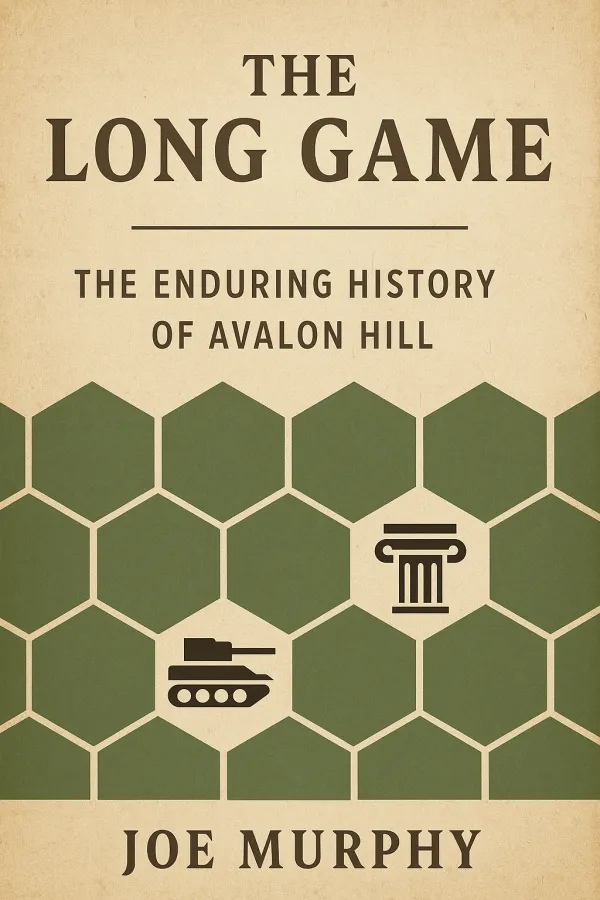
The definitive narrative history is Joe Murphy's The Long Game — The Long Game: The History Of Avalon Hill — which is the single most complete account of the company from Charles S. Roberts through the modern Wizards of the Coast era. It is the only book-length history to work directly from Monarch Avalon internal records, General magazine archives, and interviews with surviving Avalon Hill staff.
Complementary primary and secondary sources: The General magazine complete archive at https://grognard.com/thegeneral/. BoardGameGeek's Avalon Hill company page at https://boardgamegeek.com/boardgamepublisher/8/avalon-hill and the Charles S. Roberts biography at https://boardgamegeek.com/thread/1123456/. The Charles S. Roberts Awards history at https://www.csrawards.com/. James F. Dunnigan's The Complete Wargames Handbook (third edition, 2000, available online at http://www.hyw.com/books/wargameshandbook/contents.htm) for the design history. Jon Peterson's Playing at the World (2012) for the deep prehistory of the hobby. Grognard.com and consimworld.com for archived hobby coverage. Wikipedia's Avalon Hill article at https://en.wikipedia.org/wiki/Avalon_Hill is well-sourced and a good starting map of the territory. For obituaries and reappraisals of Charles S. Roberts after his death in 2010, see the New York Times obituary at https://www.nytimes.com/2010/09/24/us/24roberts.html.
10. Conclusion: The Long Game
Avalon Hill was never a large company. At its peak in the late 1970s it employed fewer than sixty people in a Baltimore office building. It never had a marketing department worth mentioning, never advertised on television, and never had a title that outsold a mid-tier Milton Bradley release. And yet, seventy-two years after Charles S. Roberts hand-assembled the first copies of Tactics, the industry Avalon Hill built is worth billions of dollars annually, employs tens of thousands of designers, developers, artists, and publishers worldwide, and shows no sign of slowing.
The reason is simple. Avalon Hill treated its players as intelligent adults who wanted difficult, historically serious, mechanically deep games — and it delivered them with a consistency and ambition no other publisher has ever matched over such a long stretch. Everything modern hobby gaming values — designer credit, rules clarity, historical fidelity, deep replayability, an engaged community around a house magazine — Avalon Hill established as the standard before anyone else was even in the room.
The imprint continues under Wizards of the Coast. The classic catalog continues under GMT, Multi-Man Publishing, and Compass Games. The design vocabulary continues everywhere. And the story of how it all happened — the Baltimore basement, the print run of Tactics, the hex grid, the sixty years that followed — is a story worth reading in full.
For the complete narrative history of the company, its games, and the people who built it, read The Long Game by Joe Murphy. Buy it on Amazon: https://a.co/d/aU3YGxF.
Share this article