Publisher History
THE HISTORY OF SPI
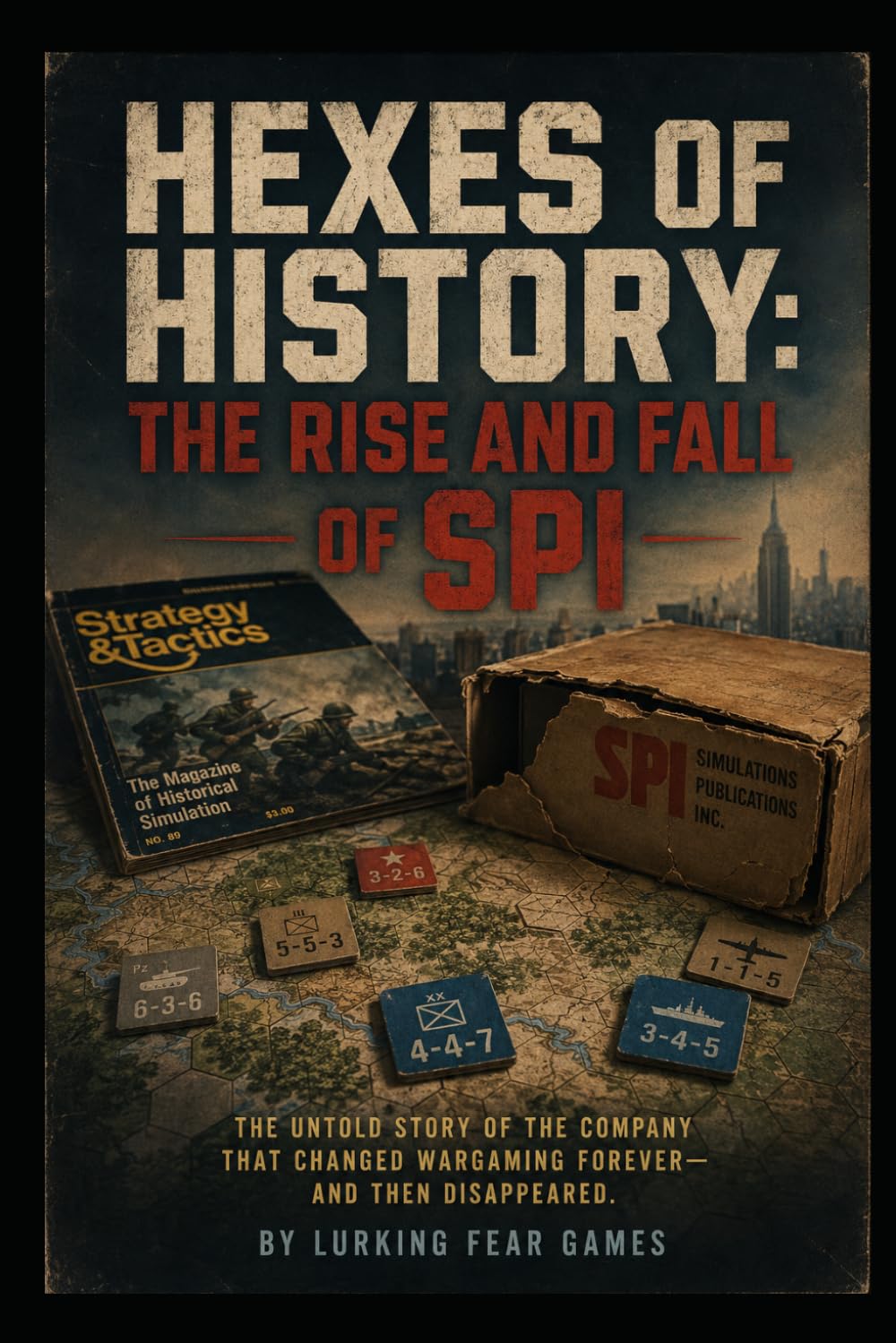
In 1969, a young designer named James F. Dunnigan took over a struggling little magazine called Strategy & Tactics and, from a cramped Manhattan office, quietly began building the most influential wargame company the hobby has ever seen. Renamed Simulations Publications, Inc.— SPI for short — the operation would spend the next thirteen years remaking the entire craft of historical simulation.
Dunnigan's obsession with playtesting and systematic design, paired with art director Redmond Simonsen's revolutionary approach to counters, maps, and typography, gave SPI a house style that was instantly recognizable and relentlessly professional. Every issue of Strategy & Tactics shipped with a complete game inside — a subscription model that turned casual readers into lifelong hobbyists and let SPI outpublish the rest of the industry combined.
SPI's catalogue is staggering. War in Europe, War in the East, and The Campaign for North Africa defined the "monster game." Sniper!, Air War, and The Next War pushed simulation detail to new extremes. The Quadrigame format packed four linked scenarios into a single box, and DragonQuest gave SPI a credible answer to Dungeons & Dragons. From StarForce: Alpha Centauri to Freedom in the Galaxy, the company proved wargame design could travel anywhere history — or imagination — cared to go.
But the same relentless expansion that made SPI dominant also made it fragile. Subscription cash flow, aggressive publishing schedules, and thin margins finally collapsed under their own weight, and in 1982 TSR — the publisher of Dungeons & Dragons — acquired SPI in one of the most bitterly remembered deals in gaming history. The Manhattan offices went dark. Designers scattered. Subscribers were left holding worthless promises. Yet SPI's fingerprints are everywhere: in Victory Games, GMT Games, Multi-Man Publishing, Compass Games, and in every modern wargame that owes its clean counters, tight rules, and playtested systems to the crew that once worked above 44th Street.
Landmark SPI Games
Strategy & Tactics Magazine (1969)
The subscription magazine with a complete wargame in every issue — SPI's engine of growth.
PanzerBlitz Rivals (Napoleon at Waterloo, 1971)
Introductory Napoleonic wargame bundled with S&T that hooked a generation.
War in Europe (1976)
The legendary 'monster game' covering the entire European theater of WWII on a massive hex map.
Sniper! (1973)
Man-to-man tactical combat that redefined skirmish-scale wargaming.
The Next War (1978)
Hypothetical NATO vs. Warsaw Pact conflict in Central Europe — Cold War simulation at its peak.
Terrible Swift Sword (1976)
Regimental-level Gettysburg simulation, the gold standard for ACW gaming.
War in the East (1974)
Grand-strategic Eastern Front campaign — the template for every monster game to follow.
Air War (1977)
Detailed modern jet combat simulation used by real pilots for training discussions.
DragonQuest (1980)
SPI's ambitious percentile-based fantasy RPG, a serious rival to D&D.
Freedom in the Galaxy (1979)
Star Wars-inspired galactic rebellion with characters, missions, and fleet combat.
StarForce: Alpha Centauri (1974)
Three-dimensional interstellar warfare, one of the earliest hard-SF wargames.
Napoleon's Last Battles (1976)
The definitive Quadrigame — four linked scenarios of the 1815 campaign in one box.
Frequently Asked Questions
What was SPI?
Simulations Publications, Inc. (SPI) was a New York City-based game publisher that operated from 1969 to 1982. Under the creative leadership of James F. Dunnigan and art director Redmond Simonsen, SPI became the largest and most prolific wargame publisher in the world, releasing hundreds of historical simulations and pioneering the modern hobby.
Who founded SPI?
SPI grew out of Poultron Press, a small operation run by designer James F. Dunnigan. In 1969 Dunnigan acquired Strategy & Tactics magazine from Chris Wagner and, together with Redmond Simonsen and a talented team of designers, reorganized the operation as Simulations Publications, Inc. Their Manhattan offices quickly became the creative center of American wargaming.
Why is SPI historically important?
SPI industrialized wargame design. It introduced the game-in-a-magazine subscription model, the Quadrigame format, monster games with thousands of counters, playtest-driven development, and clean modern graphic design standards that every publisher still borrows from. At its peak SPI published more games per year than the rest of the industry combined.
What happened to SPI?
Aggressive expansion and cash-flow problems tied to its subscription model caught up with the company in the early 1980s. In 1982 TSR — the publisher of Dungeons & Dragons — acquired SPI in a controversial deal that many industry veterans still describe as a hostile takeover. TSR shuttered most operations, alienated subscribers, and let SPI's magazine and design tradition wither.
Do SPI games still exist?
Yes. Strategy & Tactics magazine continues today under Decision Games, which also reprints many classic SPI titles. Victory Games, GMT Games, Multi-Man Publishing, Compass Games, and countless indie designers all trace their DNA back to SPI, and the original games are actively collected, played, and studied.
Does Lurking Fear publish for SPI systems?
We produce essays, retrospectives, and companion material celebrating classic SPI titles and the designers who built them. Any Lurking Fear releases in the SPI category will appear at the bottom of this page as they are published.
What formats are SPI rulebooks and companion material available in?
SPI rulebooks were originally printed as magazine inserts, folios, and boxed-game manuals. Today, Lurking Fear companion essays and retrospectives are published as digital articles and, where available, as Kindle e-books and print-on-demand paperbacks. Individual Lurking Fear titles below list their supported formats.
Where can I find SPI rulebooks and resources?
Original SPI rulebooks and back issues of Strategy & Tactics circulate on the secondary market through eBay, BoardGameGeek, and used-game vendors. Decision Games currently publishes Strategy & Tactics and reprints many classic SPI titles. Lurking Fear resources are linked directly from this hub and from our shop.
Are SPI games still available to play?
Yes. Many SPI designs remain in print or have been reissued by Decision Games, GMT Games, and other modern publishers. Original counters, maps, and rulebooks are actively traded by collectors, and several titles have digital implementations or living-rule documents maintained by the wargaming community.